



Choosing the right point of view (POV) is a key decision when writing a memoir. It shapes how readers experience your story and connect with your journey. Here’s the quick takeaway:
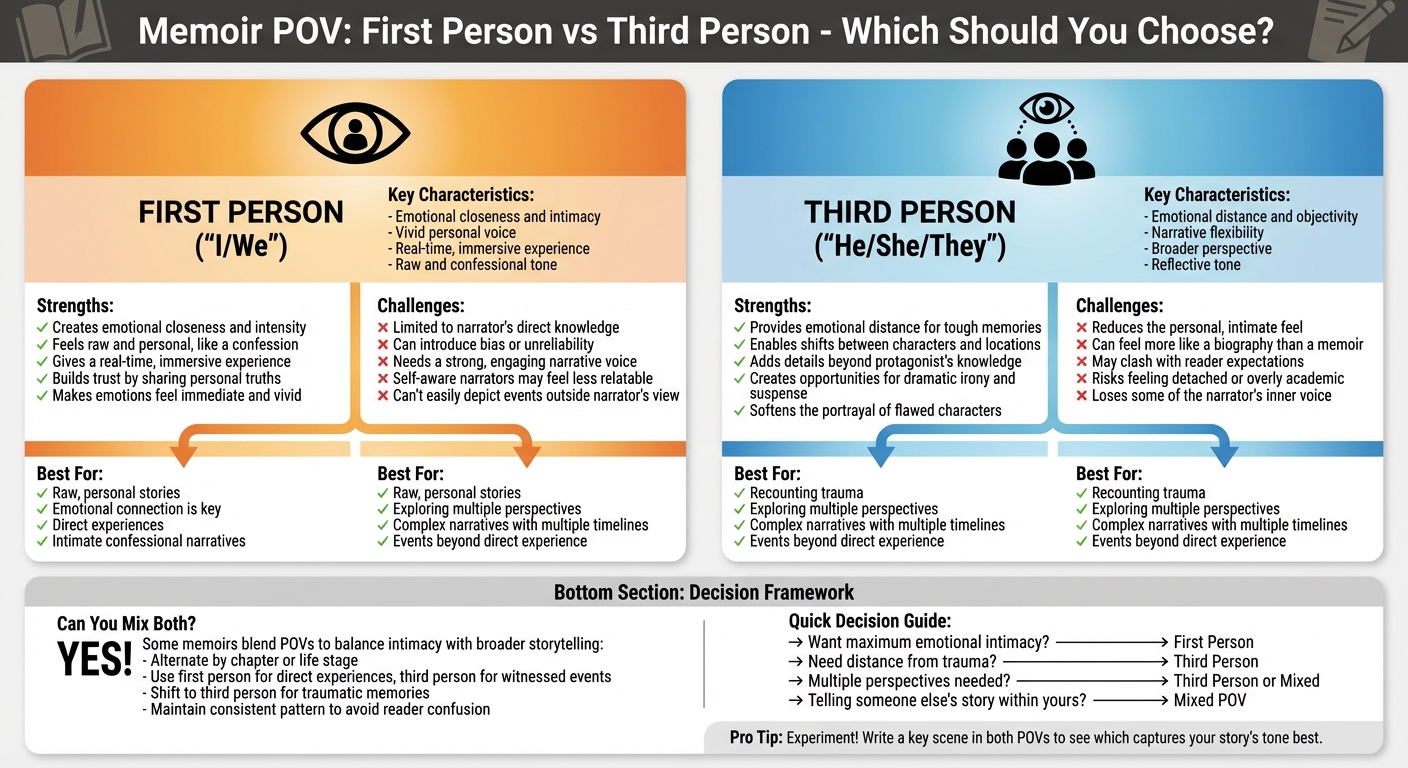
- First Person ("I/We"): Offers intimacy and immediacy, pulling readers into your personal experiences. It’s great for emotional closeness but limits perspective to what you directly know or feel.
- Third Person ("He/She/They"): Provides distance and objectivity, helpful for exploring difficult memories or including details beyond your firsthand experience. However, it can feel less personal and engaging for readers.
When to Use Each POV:
- First Person: Best for raw, personal stories where emotional connection is key.
- Third Person: Works well for recounting trauma, exploring multiple perspectives, or adding narrative flexibility.
If you’re unsure, experiment with both or even blend them. Some memoirs mix POVs to balance personal intimacy with broader storytelling.
Quick Comparison:
| POV | Strengths | Challenges |
|---|---|---|
| First Person | Emotional closeness, vivid personal voice | Limited perspective, potential bias |
| Third Person | Objectivity, flexibility for complex narratives | Loss of intimacy, may feel less personal |
The choice depends on your story’s tone and emotional goals. Want to dive deeper? Let’s break it down.
First Person vs Third Person POV in Memoir Writing: Complete Comparison Guide
First Person POV: Benefits and Drawbacks
First person is a favorite for memoir writing. It pulls readers directly into the writer’s personal experiences, creating a sense of closeness. But like any storytelling method, it has its pros and cons.
Benefits of First Person
The standout feature of first person is its emotional closeness. Using I and me allows readers to step directly into the writer’s mind, experiencing thoughts and feelings as if they were their own. Writer Alan Moore explains this power:
"The first person is very immediate and very powerful, it puts you right inside the character".
This point of view often feels genuine, as it mirrors the raw, unfiltered truth of someone’s story. For example, writing "I felt my stomach drop" carries an immediacy that "She felt her stomach drop" simply can’t match. Author and critic Lily Meyer captures this idea:
"No matter how flawed it may be, first person is unbeatable for intimacy and intensity".
Another strength is the reliance on a distinct narrative voice. A strong, unique voice can make the story vivid and engaging, even during challenging moments. It creates the illusion that events are unfolding in real time, pulling readers along for the ride.
But while first person excels in intimacy, it does have its challenges.
Drawbacks of First Person
One major limitation is its narrow perspective. The narrator can only share what they personally saw, felt, or understood at the time. If key events happened outside their view, those moments remain off-limits unless the writer risks breaking the story’s credibility.
Bias is another hurdle. First person narrators often come across as highly self-aware, which can sometimes make them less relatable. Author K.M. Weiland explains:
"First-person narrators necessarily tend to be very self-aware, and when you’re dealing with a flawed character, that can make him less likable than he would be otherwise".
Finally, first person demands a compelling voice. Without one, the story can feel flat, no matter how interesting the events. Weiland emphasizes:
"The single most important factor in choosing a first-person POV is an amazing voice. If the character’s voice is flat, why bother?".
First Person POV Comparison Table
| Benefits | Drawbacks |
|---|---|
| Creates emotional closeness and intensity | Limited to the narrator’s direct knowledge |
| Feels raw and personal, like a confession | Can introduce bias or unreliability |
| Gives a real-time, immersive experience | Needs a strong, engaging narrative voice |
| Builds trust by sharing personal truths | Self-aware narrators may feel less relatable |
| Makes emotions feel immediate and vivid | Can’t easily depict events outside narrator’s view |
Third Person POV: Benefits and Drawbacks
Using third person in memoirs isn’t as common as first person, but it comes with its own set of perks. Instead of saying, "I walked into the room", you’d write, "She walked into the room." This subtle shift creates some distance between you and your past self, which can be particularly helpful when revisiting tough or painful memories.
Benefits of Third Person
One of the biggest advantages of third person is the detachment it provides. This distance can make it easier to process and write about difficult experiences. Memoir coach Marion Roach explains this well:
"If you looked at the person you once were, perhaps it would aid you to refer to that person as ‘he’ or ‘she,’ thereby letting the writer of the tale have a look at the person under assault… and then watch as the damage sinks in".
Third person also gives you the flexibility to shift between scenes and include details your past self might have missed. This perspective allows you to paint a fuller picture, moving between locations or events and revealing information beyond what the narrator directly experienced. For characters with flaws, this approach can soften the sharp edges of self-awareness, making them feel more relatable to readers.
These strengths, however, come with their own set of challenges, which we’ll explore next.
Drawbacks of Third Person
While third person offers some clear benefits, it does come with drawbacks. The biggest challenge is the potential loss of intimacy. Memoirs are often expected to feel deeply personal, and third person can create a sense of detachment that might make the story feel more like a biography than a lived experience. Writing mentor K.M. Weiland captures this tension:
"Even deep 3rd-person will always put a little extra distance between your character and your readers. Sometimes that’s a bad thing, but sometimes it’s actually a good thing".
Readers often anticipate a first-person narrative in memoirs, so switching to "he" or "she" can feel jarring. This distance might also dilute the raw, confessional tone that many memoir readers look for, making the story feel less immediate or emotionally gripping.
Third Person POV Comparison Table
| Benefits | Drawbacks |
|---|---|
| Provides emotional distance for tough memories | Reduces the personal, intimate feel of the story |
| Enables shifts between characters and locations | Can feel more like a biography than a memoir |
| Adds details beyond the protagonist’s knowledge | May clash with reader expectations for memoirs |
| Creates opportunities for dramatic irony and suspense | Risks feeling detached or overly academic |
| Softens the portrayal of flawed characters | Loses some of the narrator’s inner voice and truth |
When to Use Third Person in Memoirs
Choosing the right point of view (POV) for your memoir is essential, and third person can offer some distinct advantages. It provides a sense of distance and flexibility that first-person narration sometimes can’t achieve. Let’s explore when third person might be the better choice.
Writing About Trauma or Difficult Events
When delving into painful or overwhelming experiences, third person can serve as a protective layer. This isn’t about avoiding the truth but rather creating a safer space to tell it. By stepping back from the immediacy of first person, you can explore raw emotions and memories without feeling fully exposed.
Memoir coach Marion Roach offers a compelling way to approach trauma in writing:
"Perhaps you’d write yourself in first person pre-attack, in third person as you separate from that healthy child you once were and in first person again as you heal".
This method reflects the way trauma often feels – like an out-of-body experience where the connection to oneself is fractured. Writing in third person can help you access those intense details without becoming overwhelmed. Over time, you might even find that this distance enables you to rewrite the scene in first person. Or, you may decide that third person better serves the emotional tone of your story as it stands.
Using third person in these moments not only provides a sense of safety but also opens the door to more nuanced storytelling techniques.
Blending Perspectives in Complex Narratives
Third person is also invaluable when your memoir extends beyond your personal experiences. While first person offers intimacy, it has limits when you’re recounting events you didn’t directly witness. For example, you might want to explore your grandmother’s immigration story or describe dynamics in your parents’ marriage during a time when you weren’t present. First person simply can’t authentically capture these moments.
Alan Moore highlights how third person allows writers to step into events far removed from their own perspective. This flexibility lets you shift between characters, locations, or even time periods without disrupting the flow of your narrative.
To make this approach work, it’s crucial to establish the use of third person early on in your memoir. A sudden switch late in the story can feel jarring to readers. Instead, you might alternate between your first-person reflections and third-person reconstructions of family history right from the beginning. This way, readers will grow accustomed to the shifts and follow the narrative seamlessly.
sbb-itb-e3574dd
Mixing First and Third Person
Memoir writers don’t have to stick to just one point of view (POV) throughout their work. Blending first and third person can bring a mix of closeness and flexibility to the narrative. This technique works particularly well when your story covers multiple time periods, includes other people’s experiences, or requires a shift in emotional tone. It allows writers to adjust the level of emotional connection while setting up detailed narrative scenes later on.
Alternating POVs for Different Story Elements
Switching between first and third person can help balance personal intimacy with a broader perspective. For instance, you might use first person for moments you directly experienced, then shift to third person to recount events you didn’t witness or to create emotional distance from difficult memories.
Writing instructor Pooja Mittal Biswas suggests a creative way to combine these perspectives:
"You can have the main character still acting and experiencing things in third-person, while a disembodied narrator narrates bits and pieces of the story in first-person… This allows you to bridge first-person and third-person perspectives and can be a means of adding another layer of depth, irony, or humor".
Virginia Woolf’s Orlando offers a great example of this technique. The protagonist’s actions are described in third person, while a first-person biographer provides witty commentary and directly speaks to the reader.
To avoid confusing your audience, maintain a consistent pattern of alternating POVs, whether by chapter or life stage. Book editor Jessi Rita Hoffman warns that abrupt or isolated shifts can disrupt the flow and leave readers disoriented. Establishing a clear structure from the start will help keep the narrative smooth and engaging.
Examples of Memoirs That Mix POVs
Plenty of memoirs showcase how mixing POVs can enhance storytelling. Take, for example, Dan, who used a "tri-voice" structure to reflect different stages of his life. Or Shannon, who alternated between her present-day investigation and a third-person account of her mother’s life. Dan’s approach captured the evolution of his perspective over time, while Shannon’s method combined the emotional immediacy of her personal journey with the objectivity needed to present researched details.
Even works of fiction offer inspiration. Marcus Zusak’s The Book Thief uses a "first person omniscient" narrator – Death – who speaks in "I" while also revealing the inner lives of other characters. This creative choice demonstrates how POV techniques can push the boundaries of traditional storytelling.
Using Meminto Stories to Apply POV Choices

Once you’ve chosen the point of view (POV) for your memoir, it’s crucial to have tools that help you stay true to your narrative structure. Meminto Stories offers features specifically designed to help you implement your chosen POV, whether you’re working with a single perspective or blending multiple ones. These tools ensure your narrative tone stays consistent and aligned with the strategies we’ve discussed earlier.
Guided Prompts for First-Person POV
Meminto Stories includes guided prompts to help you tap into what memoir experts call "bubbles of memory." These are vivid, self-contained moments that bring first-person storytelling to life. Rather than following a strict chronological order, the prompts encourage you to focus on sensory details, dialogue, and actions that evoke emotional depth and authenticity.
These prompts also help you balance your reflective voice with the immediacy of your in-the-moment perspective. As freelance editor Sarah Chauncey explains:
"The most engaging memoirs are ones in which the author sticks to their POV at the moment of events".
To enhance this process, Meminto Stories offers a speech-to-text conversion tool. This feature lets you record your natural speaking voice, which can be especially effective for first-person narratives. It helps you develop what writing instructors call the "narrator voice" – a conversational, personal tone that feels like you’re speaking directly to the reader. Additionally, the platform’s prompts guide you in using dialogue to fill in gaps, revealing how others perceived you, even when writing from a limited first-person perspective.
If your memoir requires shifts or blends in perspective, Meminto Stories provides flexible options to customize your chapters accordingly.
Customizable Chapters for Mixed or Third-Person POV
For writers exploring mixed perspectives or incorporating third-person sections, Meminto Stories allows you to customize your book’s structure beyond standard templates. This feature makes it easier to organize fractured timelines or alternate POVs.
This customization is especially useful when writing about traumatic events. Switching to third person can create emotional distance and offer a more objective lens for recounting difficult memories. These structural tools align with the mixed POV strategies discussed earlier, helping you keep your narrative cohesive even when transitioning between perspectives.
Whether you’re importing text from a Word document or starting your memoir from scratch, Meminto Stories gives you the flexibility to experiment with POV while ensuring your story remains seamless and well-structured.
Choosing the Right POV for Your Memoir
Picking the right point of view (POV) for your memoir is all about shaping the reader’s experience. Writing in first person creates a powerful sense of connection by using "I" and "me", pulling readers directly into your personal journey. Freelance editor Sarah Chauncey explains it well:
"Imagine yourself as a virtual reality camera: In each scene, including flashbacks, you’re limited to what information came into that camera, and how you experienced and interpreted it at the time".
On the other hand, third person gives you some breathing room. It can be particularly helpful when tackling difficult topics, such as trauma, or when you need to step back and view events with a more objective eye. Within third person, you have options: a limited perspective that sticks to one character’s view or an omniscient one that explores multiple viewpoints and uncovers hidden layers. Your choice depends on how much emotional distance you want to create.
Your POV should reflect the emotional heart of your story. Writer Kristen Overman highlights the importance of this:
"Showing what you felt about it tells the reader why the experience mattered, why you still carry it with you today".
Whether you lean into the raw intimacy of first person or the reflective distance of third person, your POV should align with the emotions you’re trying to convey.
If you’re unsure, try experimenting. Write a key scene in both first and third person to see which approach better captures the tone and depth you’re aiming for. Some memoirists stick with first person but switch to third person for particularly difficult memories. This kind of trial and error can help you find the voice that feels most true to your story and its purpose.
FAQs
Should I write my memoir in first or third person?
Deciding whether to write your memoir in first person or third person comes down to the kind of connection you want to build with your readers. Writing in first person (“I”) creates a close, personal bond. It invites readers into your inner world, letting them experience your thoughts, emotions, and memories almost as if they were their own. This perspective is perfect for diving deep into personal reflections or sharing raw, heartfelt moments.
On the other hand, third person (“he/she”) offers a bit of distance, which can make the narrative feel more neutral or observational. This style works well if you’re aiming to include multiple viewpoints, explore family dynamics, or set your story against a broader historical backdrop. However, it might lack the personal immediacy that memoir readers often crave.
If you’re unsure, try writing a key scene in both perspectives. See which version feels more natural and engaging to you. Once you’ve decided, tools like Meminto Stories can help transform your narrative into a beautifully bound hardcover memoir.
Can combining first and third person improve my memoir?
Mixing first-person and third-person perspectives in your memoir can bring a fresh dimension to your storytelling. Writing in the first person lets you share your personal thoughts and emotions directly, creating a close, intimate connection with readers. On the other hand, third-person narration offers a broader, more observational lens, helping to provide context or emphasize pivotal moments in your story.
By blending these perspectives, you can strike a balance between emotional closeness and narrative versatility, offering readers a more layered and engaging experience.
Why might writing about traumatic memories in third person be helpful?
Writing about traumatic memories in the third person can help create a buffer between the writer and their emotions, making it less overwhelming to revisit tough experiences. This approach provides a bit of emotional distance, allowing writers to delve into their stories with a clearer, more detached perspective.
Using third person also softens the emotional weight of reliving painful events. It offers a safer space to process and share these memories, giving the writer room to reflect without feeling completely immersed in the intensity of the moment.