How to Write Your Testimony: A Simple Structure, 30 Prompts and an Example
 by Albert Brückmann5 min read

To write your testimony, tell your story in three parts: your life before or apart from faith, the moment or season in which faith became real to you, and how your life has been different since. Keep a spoken testimony to three to five minutes, be specific rather than general, and let doubts and quiet seasons stay in the story. Below you will find each part explained, 30 prompts to help you remember, a short example and a way to keep your faith story for the people who come after you.
The three-part structure
The structure many churches teach goes back to the way Paul told his own story before King Agrippa: who he was, what happened on the road, and what he did afterwards. It works because it is the shape of every good story.
1. Before
Describe your life before faith mattered to you, or the part of your life that was apart from it. You do not need a dramatic past. What were you looking for? What did you rely on? One or two concrete details are enough: where you lived, what filled your days, what you were afraid of.
2. The turning point
Tell how faith became real to you. For some it is a single evening; for others it is a season, a person, a crisis or a slow realisation. Describe it as a scene: where you were, who was there, what you thought. Specific beats spectacular.
3. Since then
What changed? Not everything was solved, and saying so makes your story credible. Describe what your faith means in your everyday life now: in your marriage, your work, your grief, your hope. End with one sentence you would want a listener to remember.
How long should a testimony be?
| Setting | Length | What to focus on |
|---|---|---|
| Small group or church service | 3 to 5 minutes, about 400 to 600 words | one turning point, told as a scene |
| Baptism or membership | 1 to 3 minutes, about 150 to 400 words | why you are taking this step now |
| Written for your family | no limit | your whole life, with faith in every chapter |
30 prompts to help you write your testimony
Answer the ones that open something up and skip the rest.
Before
- What did your family believe when you were a child?
- Where did you first hear about God, and what did you think?
- What did you rely on when life got hard?
- What were you searching for in your teens or twenties?
- Who was the first person whose faith you noticed?
- Was there a time you wanted nothing to do with church? Why?
- What did you think a Christian was, before you became one?
- What were you most afraid of?
- What did success look like to you then?
- Which question did you not have an answer to?
The turning point
- Where were you when faith became real to you?
- Who was there, or who had prayed for you?
- Was it one moment or a long season?
- What did you pray, if you remember it?
- Which Bible verse, song or sermon stayed with you?
- What did you have to let go of?
- How did the people around you react?
- Did anything change the very next day?
- If you grew up in faith: when did it become your own?
- What would you say to the person you were just before that moment?
Since then
- What is different in your everyday life?
- When was your faith tested most?
- Which doubt have you wrestled with, and where are you with it today?
- How has faith shaped your marriage, your parenting or your friendships?
- Where have you seen God at work in a hard season?
- Which habit or practice sustains you?
- Who have you been able to help because of what you went through?
- What do you still not understand?
- What do you hope your children and grandchildren believe about God?
- If someone remembers one sentence from your story, what should it be?
A short example
The following example is invented to show the structure. Yours will sound different, and it should.
I grew up in a family that went to church at Christmas and Easter. By my thirties I had a good job, a mortgage and a habit of lying awake at three in the morning, adding up everything that could go wrong.
When my daughter was born with a heart defect, a neighbour I barely knew left a meal at our door every Tuesday for two months. On the last Tuesday I asked her why. She said, “Because someone did it for me.” That evening, in the hospital chapel, I prayed for the first time since I was a boy. Nothing dramatic happened. I just stopped feeling alone.
My daughter is eleven now. I still lie awake sometimes. But I know who I am talking to at three in the morning, and every Tuesday our family cooks for someone.
Mistakes to avoid
- Church language outsiders will not follow. Say what you mean in everyday words.
- Exaggerating the before. An ordinary life is a valid starting point.
- Preaching. Tell your story and let the listener draw their own conclusion.
- Making yourself the hero. The story is about what happened to you, not about how well you did.
- Exposing others. Name family members with care and ask permission when a story is theirs too.
From testimony to life story
A spoken testimony fits one turning point into five minutes. But faith rarely lives in one moment. It runs through childhood, marriage, work, losses and late years, and it is the part of a life that children and grandchildren most often say they never asked about.
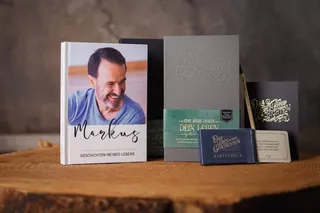
The Christian Life Story Book from Meminto keeps that whole story. It is the same book as the standard Life Story Book, with a different set of questions: faith is woven into every chapter, from the home you grew up in to your turning points, doubts and prayers. The questions are not tied to a denomination, and any of them can be skipped or rewritten. You answer by speaking or typing, add photos, and the answers become a printed hardcover your family can keep. If you would rather plan the chapters yourself first, our autobiography outline template is a good place to start.